Transforming Paper Chaos into Digital Clarity: How AI Agents Turn Legacy Blueprints into ERP-Ready Data
Introduction — From Manual Entry to Intelligent Automation:
Stacks of aging blueprints filled with handwritten notes, faded lines, and cryptic part numbers have long been a bottleneck for manufacturing teams. Converting these documents into structured ERP data often requires hours of manual effort — and even small mistakes can disrupt procurement, delay production, or introduce costly errors.
Today, agent-driven AI workflows are changing that reality. By combining smart scanning, computer vision, structured data pipelines, and ERP validation, organizations can transform legacy engineering drawings into accurate, production-ready digital assets — without endless manual typing.
Why Blueprint Digitization Needs a Workflow Approach:
Many teams treat digitization as a simple OCR task, but blueprints are far more complex than plain text documents. They contain:
- Technical annotations and tolerances
- Part hierarchies and revision notes
- Non-standard layouts and handwritten edits
A structured, multi-stage workflow ensures that extracted data is not only readable but also reliable enough for direct integration with systems like SAP or Oracle.
Key Concepts Explained Simply:
Agent-Driven Digitization
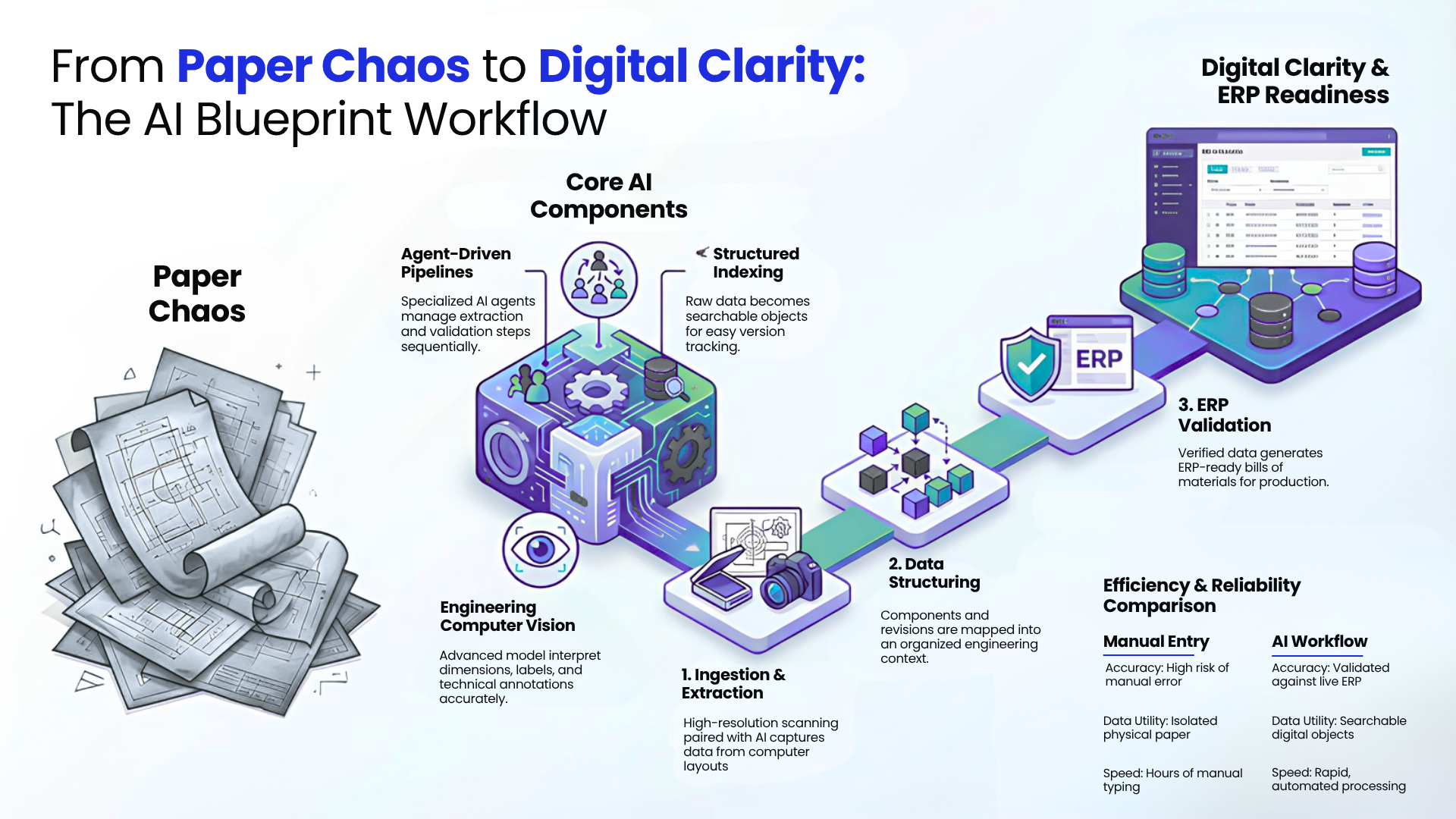
Instead of one monolithic tool, specialized AI agents handle scanning, extraction, structuring, and validation as connected steps in a pipeline.
Computer Vision for Engineering Drawings
Vision models analyze shapes, text regions, and diagram context to identify part numbers, dimensions, and labels.
Structured Indexing
Raw text becomes organized data objects — enabling search, version tracking, and cross-referencing across blueprint revisions.
The Four-Step Blueprint Digitization Pipeline:
1. Scanning and Ingestion
High-resolution scanning is the foundation of the entire workflow.
- Capture clear images with minimal distortion.
- Preserve handwritten annotations and fine measurement lines.
- Store scans in scalable cloud storage such as Google Cloud Storage for centralized access.
Consistent lighting and alignment significantly improve downstream accuracy.
2. Computer Vision and Information Extraction
An AI agent processes scanned schematics using computer vision techniques.
- Detects part numbers, labels, and measurement details.
- Handles variations in fonts, line thickness, and layout.
- Converts visual elements into raw textual and numerical data.
Because no two blueprints look identical, calibration and continuous tuning are essential.
3. Data Structuring and Indexing
Extracted data is organized into structured objects rather than unstructured text.
- Components, revisions, and positional data are mapped clearly.
- Indexing tools create searchable datasets.
- Version comparisons become easier, reducing confusion during updates.
This stage transforms fragmented information into meaningful engineering context.
4. ERP Validation and BOM Creation
Before integration, the system validates extracted parts against live ERP inventory.
- Obsolete or mismatched part numbers are flagged automatically.
- Bills of Materials (BOM) are generated in ERP-ready format.
- Verified data flows directly into procurement and production systems.
Example: If a blueprint lists PN-12345A but inventory uses PN-12345B, the agent highlights the discrepancy for review.
Practical Tips for Successful Implementation:
- Model Tuning: Regularly retrain vision models to handle new drawing styles.
- Scan Quality: Standardized scanning processes reduce recognition errors.
- ERP Data Freshness: Keep inventory records updated to avoid false mismatch alerts.
- Human Oversight: Engineers should review ambiguous cases where context matters.
Real-World Benefits for Manufacturing Teams:
For Technical Teams
- Reduced manual data entry
- Faster BOM generation
- Improved accuracy across revisions
For Operations and Business Leaders
- Fewer procurement errors
- Faster project turnaround
- Better utilization of engineering talent
Common Challenges and How to Avoid Them:
- Treating blueprint extraction as simple OCR instead of structured interpretation.
- Ignoring metadata such as revision history.
- Underestimating the importance of standardized scanning workflows.
Addressing these issues early ensures smoother adoption and higher reliability.
Future Scope — From Digitization to Intelligent Manufacturing:
Once blueprints are structured digitally, organizations can unlock advanced capabilities:
- Predictive analysis of design changes
- Automated compliance checks
- Integration with digital twin systems
- AI-assisted design optimization
Digitization becomes not just a cleanup exercise, but a foundation for smarter manufacturing workflows.
Conclusion — Turning Legacy Documents into Strategic Assets:
Agent-driven blueprint digitization transforms outdated engineering documentation into structured, validated, and actionable data. Instead of spending hours entering part numbers and verifying details manually, engineers can focus on design, analysis, and innovation.
Key Takeaways:
- High-quality scanning is critical for accurate extraction.
- Computer vision enables precise interpretation of complex drawings.
- Structured indexing improves searchability and version control.
- ERP validation ensures BOM accuracy before production begins.
- AI enhances engineering workflows — it doesn’t replace human expertise.
With the right workflow in place, stacks of paper blueprints evolve from operational burdens into reliable digital resources that accelerate manufacturing efficiency and reduce costly errors.
Related Blogs

When Your System Detects Failure Before You Even Log In: The Rise of AI-Driven Incident Response